§ 01 — Computer Programming 2
Lesson 4: Structures
01
What Is a Structure?
In Lesson 1 (Arrays) you kept many values of the same type under one name. Real records are not like that. A student has a name (text), a year level (a whole number), and a GWA (a decimal). Those are three different types, but they describe one person and belong together.
You could keep them in three parallel arrays, names[], years[], and gwas[], where index 2 in each array is the same student. That works until you sort one array and forget the others: now Ana's name sits next to Ben's GWA, and the bug is hard to spot.
A structure (struct) fixes this. It groups related variables, which may have different types, under one name. Each variable inside a structure is called a member (some books say field).
Think of a structure definition as a blank enrollment form. The form lists the blanks (name, year, GWA) but holds no data yet. Every variable you declare with that structure type is one filled-in copy of the form.
| Array | Structure | |
|---|---|---|
| Types of the items | all the same | can be different |
| How you reach one item | by index: a[2] | by member name: s.gwa |
Copy the whole thing with = | not allowed | allowed, copies every member |
| Typical use | a list of scores | one record (a student, a book, an item) |
You will often combine the two: an array of structures is a whole class list, one record per student.
02
Declaring Structures and Accessing Members
Defining the Structure
struct student {
    char  name[30];
    int   year;
    float gwa;
};          /* the semicolon after the brace is required */
This creates a new type called struct student. The word after struct (student) is the tag. Defining the type sets aside no memory. It only describes the shape. Put the definition above main() so every function can use it.
Declaring and Initializing Variables
struct student a, b;                          /* two variables, garbage inside */
struct student c = {"Ana Reyes", 1, 1.75f};   /* values in member order */
The values in braces go into the members in the order they were listed in the definition. Members you leave out become 0, just like a partly filled array.
The Dot Operator
Use a dot between the variable and the member name to reach one member: c.year, c.gwa, c.name. A member works like any ordinary variable of its type.
#include <stdio.h>
#include <string.h>

struct student {
    char  name[30];
    int   year;
    float gwa;
};

int main(void) {
    struct student a = {"Ana Reyes", 1, 1.75f};
    struct student b;

    strcpy(b.name, "Ben Cruz");   /* b.name = "Ben Cruz"; does not compile */
    b.year = 1;
    b.gwa  = 2.25f;

    printf("%s, year %d, GWA %.2f\n", a.name, a.year, a.gwa);
    printf("%s, year %d, GWA %.2f\n", b.name, b.year, b.gwa);
    return 0;
}
Output:
Ana Reyes, year 1, GWA 1.75
Ben Cruz, year 1, GWA 2.25
Reading Members with scanf
scanf("%d", &a.year);    /* & goes in front of the whole a.year */
scanf("%29s", a.name);   /* name is a char array: no & (one word only) */
The dot runs before &, so &a.year means "the address of a.year", which is what you want.
Copying and Comparing
b = a; copies every member of a into b, even the name array. That is something plain arrays cannot do. But if (a == b) does not compile: C has no == for whole structures. Compare member by member, with strcmp for the strings.
Common Mistakes
- Forgetting the
;after the closing}of the definition. - Writing
student a;instead ofstruct student a;. In C the wordstructis part of the type name (unless you usetypedef, coming up later in this lesson). - Assigning a string with
=, as ina.name = "Ana";. Usestrcpy(a.name, "Ana");from<string.h>. - Comparing two structures with
==.
03
Arrays of Structures
A single structure variable holds one record. To hold a whole class, declare an array of structures:
struct student cls[40]; /* 40 records, cls[0] to cls[39] */
Read cls[i].gwa from left to right: take element i of the array, then its gwa member. Writing cls.gwa[i] is wrong, because cls is the array, not a structure, and gwa is not an array.
The program below prints a class list, the class average, and the top student. In most Philippine colleges 1.00 is the highest grade, so the best GWA is the smallest number, and the comparison uses <.
#include <stdio.h>

struct student {
    char  name[30];
    int   year;
    float gwa;
};

int main(void) {
    struct student cls[4] = {
        {"Ana Reyes",    1, 1.75f},
        {"Ben Cruz",     1, 2.25f},
        {"Carla Santos", 1, 1.50f},
        {"Dan Lim",      1, 2.50f}
    };
    int i, best = 0;
    float total = 0;

    for (i = 0; i < 4; i++) {
        printf("%-13s %.2f\n", cls[i].name, cls[i].gwa);
        total += cls[i].gwa;
        if (cls[i].gwa < cls[best].gwa)
            best = i;
    }
    printf("Class average: %.2f\n", total / 4);
    printf("Top student:   %s\n", cls[best].name);
    return 0;
}
Output:
Ana Reyes     1.75
Ben Cruz      2.25
Carla Santos  1.50
Dan Lim       2.50
Class average: 2.00
Top student:   Carla Santos
Notice that best stores an index, not a GWA. Once you know the index, cls[best] gives you the whole record, name and all.
Why This Beats Parallel Arrays
When you sort an array of structures, you swap whole records (temp = cls[i]; cls[i] = cls[i + 1]; cls[i + 1] = temp;). The name, year, and GWA always move together, so they can never get out of step.
Common Mistakes
cls.gwa[i]instead ofcls[i].gwa.- Running the loop to
i <= 4for a 4-element array. Indexes still stop at size − 1, exactly as in Lesson 1 (Arrays). - Initializing
totalorbestinside the loop, which resets them on every pass.
04
typedef and Nested Structures
typedef: A Shorter Name
Typing struct student every time gets tiring. typedef gives an existing type a second name:
typedef struct {
    char  name[30];
    int   year;
    float gwa;
} Student;           /* Student is now a type name */

Student s;           /* no "struct" needed */
Student cls[40];
typedef does not create a new kind of data. It only adds a name. You can also name a tagged structure: typedef struct student Student; makes Student and struct student mean the same type.
A common convention is to start typedef names with a capital letter (Student, Date) so they stand out from variables.
Nested Structures
A member can itself be a structure. A student has a birthday, and a birthday is a month, a day, and a year:
#include <stdio.h>

typedef struct {
    int month, day, year;
} Date;

typedef struct {
    char name[30];
    Date birthday;          /* a structure inside a structure */
} Student;

int main(void) {
    Student s = {"Ana Reyes", {3, 14, 2006}};

    s.birthday.year = 2007;     /* outer member, then inner member */
    printf("%s was born on %d/%d/%d\n", s.name,
           s.birthday.month, s.birthday.day, s.birthday.year);
    return 0;
}
Output:
Ana Reyes was born on 3/14/2007
To reach a member of the inner structure, use one dot per level: s.birthday.year means "the year of the birthday of s". The initializer uses inner braces for the inner structure: {3, 14, 2006} fills birthday.
Common Mistakes
- Writing
s.yearwhenyearbelongs to the inner structure. Every level needs its own dot. - Defining
DateafterStudent. The compiler reads from top to bottom, so the inner type must already exist when the outer one uses it. - Forgetting the type name after the closing brace of a
typedef struct { ... }, which leaves you with no name to use.
05
Structures and Functions
You can pass a structure to a function and return one from a function, just like an int.
Passing by Value Copies the Whole Structure
When you pass a structure the normal way, the function gets a copy of every member. This is call by value from CP1 Lesson 6, applied to a structure. Changing the copy does nothing to the caller's variable. If you want the change, return the changed structure and assign it.
#include <stdio.h>

typedef struct {
    int x, y;
} Point;

void move_copy(Point p) {
    p.x = p.x + 10;          /* changes the copy only */
}

Point moved(Point p, int dx) {
    p.x = p.x + dx;
    return p;                /* send the changed copy back */
}

int main(void) {
    Point a = {1, 2};

    move_copy(a);
    printf("after move_copy: (%d, %d)\n", a.x, a.y);

    a = moved(a, 10);
    printf("after moved:     (%d, %d)\n", a.x, a.y);
    return 0;
}
Output:
after move_copy: (1, 2)
after moved:     (11, 2)
move_copy changed its own copy and threw it away. moved returned its copy, and a = moved(a, 10); stored it back.
Arrays of Structures Are Not Copied
An array parameter is really a pointer to the first element (Lesson 3, Pointers). So when you pass an array of structures, the function works on the caller's records directly:
void curve(Student list[], int n) {
    int i;
    for (i = 0; i < n; i++)
        list[i].gwa -= 0.25f;     /* changes the caller's array */
}
If a function should only read the array, write the parameter as const Student list[]. The compiler will then refuse any line that tries to change a record.
Common Mistakes
- Expecting a function to change a structure that was passed by value. It changed a copy.
- Returning a structure but forgetting to assign the result:
moved(a, 10);alone throws the answer away. - Passing a large structure by value inside a loop. Every call copies all of it. The next section shows the better way: pass its address.
06
Pointers to Structures: The Arrow Operator
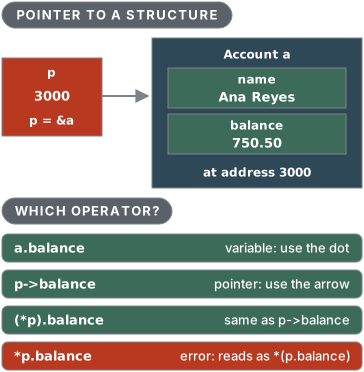
A pointer can hold the address of a structure, the same way it holds the address of an int (Lesson 3, Pointers):
Student s;
Student *p = &s;     /* p holds the address of the whole structure */
Two Ways to Reach a Member Through a Pointer
(*p).gwafollows the pointer to the structure, then picks the member. The parentheses are required: the dot runs before*, so*p.gwawould mean*(p.gwa), which does not compile becausepis not a structure.p->gwameans exactly the same thing and is easier to type and read. The arrow (a hyphen followed by>) is what C programmers use.
The rule is simple: if you have the structure itself, use the dot. If you have a pointer to it, use the arrow.
Passing a Structure by Pointer
Pass &s when a function must change the caller's structure. It is also faster for big structures, because only one address is copied instead of every member.
#include <stdio.h>
#include <string.h>

typedef struct {
    char  name[30];
    float balance;
} Account;

void deposit(Account *acc, float amount) {
    acc->balance += amount;      /* same as (*acc).balance += amount */
}

int main(void) {
    Account a;
    Account *p = &a;

    strcpy(a.name, "Ana Reyes");
    a.balance = 500.00f;

    deposit(&a, 250.50f);
    printf("%s: PHP %.2f\n", a.name, a.balance);
    printf("%s: PHP %.2f\n", p->name, (*p).balance);
    return 0;
}
Output:
Ana Reyes: PHP 750.50
Ana Reyes: PHP 750.50
Inside deposit, acc is a pointer, so it uses acc->balance. In main, a is the structure itself, so it uses a.balance. Both lines at the end print the same balance because p points at a.
Pointers and Arrays of Structures
If p points at cls[0], then p[i].gwa and (p + i)->gwa both reach record i. Pointer arithmetic moves by one whole record at a time, not one byte.
Common Mistakes
- Using the arrow on a structure variable (
a->balance) or the dot on a pointer (p.balance). Both are compile errors. - Writing
*p.balancewithout parentheses. - Using a pointer before it points anywhere.
Student *p;alone holds a garbage address. Give it one withp = &s;first.
07
Key Takeaways
- A structure groups related variables, which may have different types, under one name. Each variable inside it is a member.
- A
structdefinition is only a template and must end with;. Memory is set aside only when you declare a variable of that type. - Use the dot with a structure variable (
s.gwa) and the arrow with a pointer to one (p->gwa, which means(*p).gwa). Nested members take one dot per level:s.birthday.year. - You can copy a whole structure with
=, but you cannot compare two with==, and a string member needsstrcpy, not=. - Passing a structure to a function passes a copy. Pass its address (
&s) when the function must change it, and usetypedefto give the type a shorter name.
08
Try It: Structures
Run the code below. Add a fourth student to the array (update COUNT too), then give the bonus to a different student and predict the output before you press Run.
#include <stdio.h>

#define COUNT 3

typedef struct {
    char name[20];
    int  score;
} Student;

void give_bonus(Student *s, int points) {
    s->score += points;
}

int main(void) {
    Student cls[COUNT] = {
        {"Ana", 82},
        {"Ben", 74},
        {"Carla", 91}
    };
    int i;

    give_bonus(&cls[1], 5);

    for (i = 0; i < COUNT; i++)
        printf("%-6s %d\n", cls[i].name, cls[i].score);
    return 0;
}Pro3 reviewers locked
Part of this subject's paid reviewers. Not included in this printout.
- 09Practice Exercises, Lesson 4
- 10Worked Exam Solutions + How-to-Pass Tips, Lesson 4
- 11Code Lab, Lesson 4: Class Record
Done with this module? Track it — your progress shows on the subject list.
Studying with blockmates? Send them this lesson.
Up next
Lesson 5: File Handling→←Previous: Lesson 3: Pointers