§ 01 — Computer Programming 2
Lesson 6: Recursion
01
What Is Recursion?
In CP1 Lesson 6 (Functions) you saw main() call other functions. Nothing in C stops a function from calling itself. A function that does this is called recursive, and the technique is called recursion.
Recursion is a way of solving a problem by turning it into a smaller copy of the same problem. You keep shrinking it until it is so small that the answer is obvious, then you build the full answer back up from there.
Think of the line at the registrar during enrollment. You want to know your place in line, but you can only see the person directly in front of you. So you ask them, "What number are you?" They do not know either, so they ask the person in front of them, and so on. The person at the very front knows they are number 1 without asking anyone. That answer travels back down the line, each person adding 1, until it reaches you. That is recursion: a chain of smaller questions that ends at one question with an obvious answer.
A first example: counting down
#include <stdio.h>

void countdown(int n) {
    if (n == 0) {              /* base case: stop here */
        printf("Liftoff!\n");
        return;
    }
    printf("%d\n", n);
    countdown(n - 1);          /* recursive case: a smaller problem */
}

int main(void) {
    countdown(3);
    return 0;
}
Output:
3
2
1
Liftoff!
countdown(3) prints 3 and calls countdown(2), which prints 2 and calls countdown(1), which prints 1 and calls countdown(0). That last call prints Liftoff! and returns without calling anything, so the chain stops.
The two parts every recursive function needs
- Base case: the input so small that the function answers it directly, with no further recursive call. Here it is
n == 0. - Recursive case: the function calls itself on a smaller input and uses that result. Here it is
countdown(n - 1).
Leave out the base case and the function calls itself forever. Leave out the "smaller" part and it never reaches the base case. Either way, the program crashes. You will see why in the Recursion vs. Iteration section.
02
Base Case and Recursive Case: Factorial
The factorial of n, written n!, is the product of every whole number from 1 to n. So 4! = 4 × 3 × 2 × 1 = 24, and by definition 0! = 1.
Look at 4! closely: 4 × 3 × 2 × 1 is just 4 × (3 × 2 × 1), and 3 × 2 × 1 is 3!. So:
n! = n × (n - 1)!     for n ≥ 1
0! = 1
That definition already has a recursive case (n × (n - 1)!) and a base case (0! = 1). It translates almost word for word into C:
#include <stdio.h>

long factorial(int n) {
    if (n <= 1)                      /* base case */
        return 1;
    return n * factorial(n - 1);     /* recursive case */
}

int main(void) {
    printf("4! = %ld\n", factorial(4));
    printf("0! = %ld\n", factorial(0));
    printf("10! = %ld\n", factorial(10));
    return 0;
}
Output:
4! = 24
0! = 1
10! = 3628800
The base case uses n <= 1 instead of n == 0, because 1! is also 1. That saves one call, and it also stops safely if someone passes a negative number.
A checklist for any recursive function
Before you trust a recursive function, check all three:
- There is a base case that returns a value without calling the function again.
- Every recursive call uses a smaller input (
n - 1,n / 10, a shorter part of an array). - The smaller inputs eventually hit the base case, for every valid input.
Common mistake: a base case you can step over
long factorial(int n) {
    if (n == 0)                      /* only stops at exactly 0 */
        return 1;
    return n * factorial(n - 1);
}

/* factorial(-1) calls factorial(-2), then -3, -4, ...
   It never lands on 0, so it never stops. */
This version is correct for 0 and every positive n. But a negative argument skips right past 0 and keeps going down, so it never stops. Writing the base case as a range (n <= 1) instead of one exact value (n == 0) closes that gap.
One more limit to know: factorials grow very fast. On many compilers, including the common ones on Windows, long is only 32 bits, so 12! (479001600) is the largest factorial it can hold. 13! overflows and prints a wrong number.
03
Tracing the Call Stack
To read recursive code you need to know what the computer does on every call.
Each time a function is called, C sets aside a small block of memory for that call, called a stack frame. The frame holds the call's own copy of its parameters, its local variables, and the spot to return to when it finishes. Frames are piled on top of each other in an area called the call stack. The newest call is always on top, and only the top call is running. When it returns, its frame is removed and the call below it continues from where it stopped.
This is why recursion works at all: factorial(4) and factorial(3) each have their own n. They do not overwrite each other.
Tracing factorial(4)
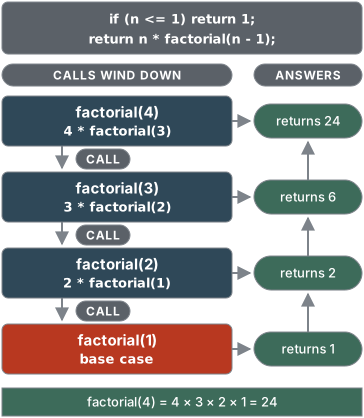
A recursive call runs in two phases. First it winds down: each call is waiting for the answer to a smaller call. Then it unwinds: the answers come back up and each waiting call finishes its multiplication.
factorial(4) = 4 * factorial(3)          waits
  factorial(3) = 3 * factorial(2)        waits
    factorial(2) = 2 * factorial(1)      waits
      factorial(1) = 1                   base case, returns 1
    factorial(2) returns 2 * 1 = 2
  factorial(3) returns 3 * 2 = 6
factorial(4) returns 4 * 6 = 24
The same trace as a table, in the order things happen:
| Step | Call | n | What happens |
|---|---|---|---|
| 1 | factorial(4) | 4 | needs factorial(3), waits |
| 2 | factorial(3) | 3 | needs factorial(2), waits |
| 3 | factorial(2) | 2 | needs factorial(1), waits |
| 4 | factorial(1) | 1 | base case, returns 1 |
| 5 | factorial(2) | 2 | returns 2 × 1 = 2 |
| 6 | factorial(3) | 3 | returns 3 × 2 = 6 |
| 7 | factorial(4) | 4 | returns 4 × 6 = 24 |
At step 4 the stack is at its deepest: four factorial frames on top of the frame for main(). The last call made (factorial(1)) is the first one to finish. That "last in, first out" order is exactly how a stack of plates works.
Before the call or after the call?
Where you put the printf() relative to the recursive call changes the output completely. This is a favorite exam question.
void down(int n) {
    if (n == 0) return;
    printf("%d ", n);      /* print BEFORE the call */
    down(n - 1);
}

void up(int n) {
    if (n == 0) return;
    up(n - 1);
    printf("%d ", n);      /* print AFTER the call */
}
down(3) prints 3 2 1: each call prints first, then goes deeper.
up(3) prints 1 2 3: each call goes deeper first, and only prints while the stack unwinds. up(3) calls up(2), which calls up(1), which calls up(0) and returns at once. Then up(1) prints 1, returns to up(2), which prints 2, then up(3) prints 3.
Rule of thumb: work done before the recursive call happens on the way down, in calling order. Work done after it happens on the way back up, in reverse order.
04
Classic Recursive Functions
These come up again and again in quizzes and lab exams. For each one, find the base case and the smaller problem first, and the code almost writes itself.
#include <stdio.h>

int sumDigits(int n) {
    if (n < 10)                          /* one digit left */
        return n;
    return n % 10 + sumDigits(n / 10);   /* last digit + the rest */
}

long power(int base, int exp) {
    if (exp == 0)                        /* anything to the 0 is 1 */
        return 1;
    return base * power(base, exp - 1);
}

int fib(int n) {
    if (n <= 1)                          /* fib(0) = 0, fib(1) = 1 */
        return n;
    return fib(n - 1) + fib(n - 2);
}

int main(void) {
    int i;
    printf("sumDigits(4096) = %d\n", sumDigits(4096));
    printf("power(2, 5) = %ld\n", power(2, 5));
    for (i = 0; i <= 9; i++)
        printf("%d ", fib(i));
    printf("\n");
    return 0;
}
Output:
sumDigits(4096) = 19
power(2, 5) = 32
0 1 1 2 3 5 8 13 21 34
Sum of digits
n % 10 is the last digit and n / 10 is everything except the last digit (integer division drops the remainder). A one-digit number is its own sum, so that is the base case.
sumDigits(4096) = 6 + sumDigits(409)
                = 6 + 9 + sumDigits(40)
                = 6 + 9 + 0 + sumDigits(4)
                = 6 + 9 + 0 + 4
                = 19
Power
Raising base to exp means multiplying base by itself exp times. So 2 to the 5th is 2 × (2 to the 4th), and anything to the 0th is 1.
power(2, 5) = 2 * power(2, 4)
            = 2 * 2 * power(2, 3)
            = 2 * 2 * 2 * power(2, 2)
            = 2 * 2 * 2 * 2 * power(2, 1)
            = 2 * 2 * 2 * 2 * 2 * power(2, 0)
            = 2 * 2 * 2 * 2 * 2 * 1 = 32
Fibonacci
Each Fibonacci number is the sum of the two before it: 0, 1, 1, 2, 3, 5, 8, 13, 21, 34, and so on. This function has two recursive calls, so it needs two starting values: fib(0) = 0 and fib(1) = 1. The test n <= 1 returning n covers both.
Two calls per level means the work branches like a tree. fib(5) calls fib(4) and fib(3), but fib(4) also calls fib(3), so the same values get recomputed again and again:
| Call | Result | Total calls made |
|---|---|---|
| fib(5) | 5 | 15 |
| fib(10) | 55 | 177 |
| fib(20) | 6765 | 21,891 |
| fib(30) | 832040 | 2,692,537 |
Going from fib(20) to fib(30) multiplies the work by more than 100. A simple loop that keeps the last two numbers needs only about 30 steps for fib(30). Keep this example in mind: recursion is elegant, but it is not automatically efficient.
05
Recursion vs. Iteration
Anything you can do with recursion you can also do with a loop (iteration), and the other way around. Here is factorial both ways:
long factorialLoop(int n) {
    long result = 1;
    int i;
    for (i = 2; i <= n; i++)
        result = result * i;
    return result;
}
Same answer, no stack of waiting calls: one frame, one loop.
| Recursion | Iteration (loop) | |
|---|---|---|
| How it repeats | the function calls itself | for, while, do-while |
| How it stops | reaching the base case | the loop condition becomes false |
| Memory | one stack frame per active call | one frame, reused |
| Speed | slower: every call has overhead | usually faster |
| Code | short and close to the math definition | sometimes longer |
| If it never stops | stack overflow, the program crashes | infinite loop, the program hangs |
Stack overflow
The call stack is small (often around 1 MB on Windows and 8 MB on Linux or macOS). Every active call takes a frame from it. If recursion goes too deep, the stack runs out of room and the program crashes. This is called a stack overflow. On Linux or macOS you usually see Segmentation fault; on Windows the program just stops, often with a non-zero exit code.
It happens in two ways:
- Infinite recursion: no base case, or a recursive call that never gets closer to it, like
factorial(-1)with ann == 0base case. - Recursion that is correct but too deep:
#include <stdio.h>

long sumTo(long n) {
    if (n == 0)
        return 0;
    return n + sumTo(n - 1);
}

int main(void) {
    printf("%ld\n", sumTo(100));
    printf("%ld\n", sumTo(1000000));   /* far too deep: likely crashes */
    return 0;
}
The first call is fine and prints 5050. The second needs a million frames waiting at the same time, so the program crashes before printing anything else. (Built with heavy optimization, some compilers rewrite this function into a loop and it survives. Do not count on it.)
When should you use recursion?
Use it when:
- The problem is naturally defined in terms of a smaller version of itself: factorial, power, sum of digits, greatest common divisor.
- The problem splits in half each step, like binary search in Lesson 7 (Searching and Sorting). The depth stays tiny: about 20 calls for a million items.
- The data has a branching shape, like folders inside folders, which you will meet in later data structures courses.
Prefer a loop when:
- A simple loop does the same job clearly, like summing 1 to n.
- The input can be large, so the depth could be large.
- The recursion repeats work, like the naive
fib().
Common mistakes
- Forgetting the base case, or writing one the input can skip over.
- Recursing on the same input (
f(n)insidef(n)) or a bigger one (f(n + 1)) instead of a smaller one. - Forgetting
returnin front of the recursive call in a function that returns a value.factorial(n - 1);alone throws the answer away. - Assuming the base case runs first. It runs last on the way down, and its result is the first one returned.
06
Key Takeaways
- A recursive function calls itself. It needs a base case that answers without recursing, and a recursive case that calls itself on a smaller input.
- Every recursive call must move toward the base case. If it can skip past it or never reach it, the calls never end.
- Each call gets its own stack frame with its own copy of the parameters. Calls wind down until the base case, then the answers unwind back up in reverse order.
- Code before the recursive call runs on the way down (
down(3)prints3 2 1); code after it runs on the way back up (up(3)prints1 2 3). - Too many calls at once cause a stack overflow. Use recursion when the problem shrinks naturally or splits in half; use a loop when a loop is simpler or the depth could be large.
07
Try It: Recursion
Run it and read the indented trace: each level of indent is one more frame on the call stack. Then try factorial(6, 0), or change the Fibonacci loop to stop at 20 instead of 10.
#include <stdio.h>

void indent(int depth) {
    int i;
    for (i = 0; i < depth; i++)
        printf("  ");
}

long factorial(int n, int depth) {
    long result;
    indent(depth);
    printf("factorial(%d) called\n", n);
    if (n <= 1)
        result = 1;                                 /* base case */
    else
        result = n * factorial(n - 1, depth + 1);   /* recursive case */
    indent(depth);
    printf("factorial(%d) returns %ld\n", n, result);
    return result;
}

int fib(int n) {
    if (n <= 1)
        return n;
    return fib(n - 1) + fib(n - 2);
}

int main(void) {
    int i;
    printf("Answer: %ld\n\n", factorial(4, 0));

    printf("Fibonacci: ");
    for (i = 0; i <= 10; i++)
        printf("%d ", fib(i));
    printf("\n");
    return 0;
}Pro3 reviewers locked
Part of this subject's paid reviewers. Not included in this printout.
- 08Practice Exercises, Lesson 6
- 09Worked Exam Solutions + How-to-Pass Tips, Lesson 6
- 10Code Lab, Lesson 6: Finish the Recursion
Done with this module? Track it — your progress shows on the subject list.
Studying with blockmates? Send them this lesson.
Up next
Lesson 7: Searching and Sorting→←Previous: Lesson 5: File Handling